Sunday, July 31, 2011

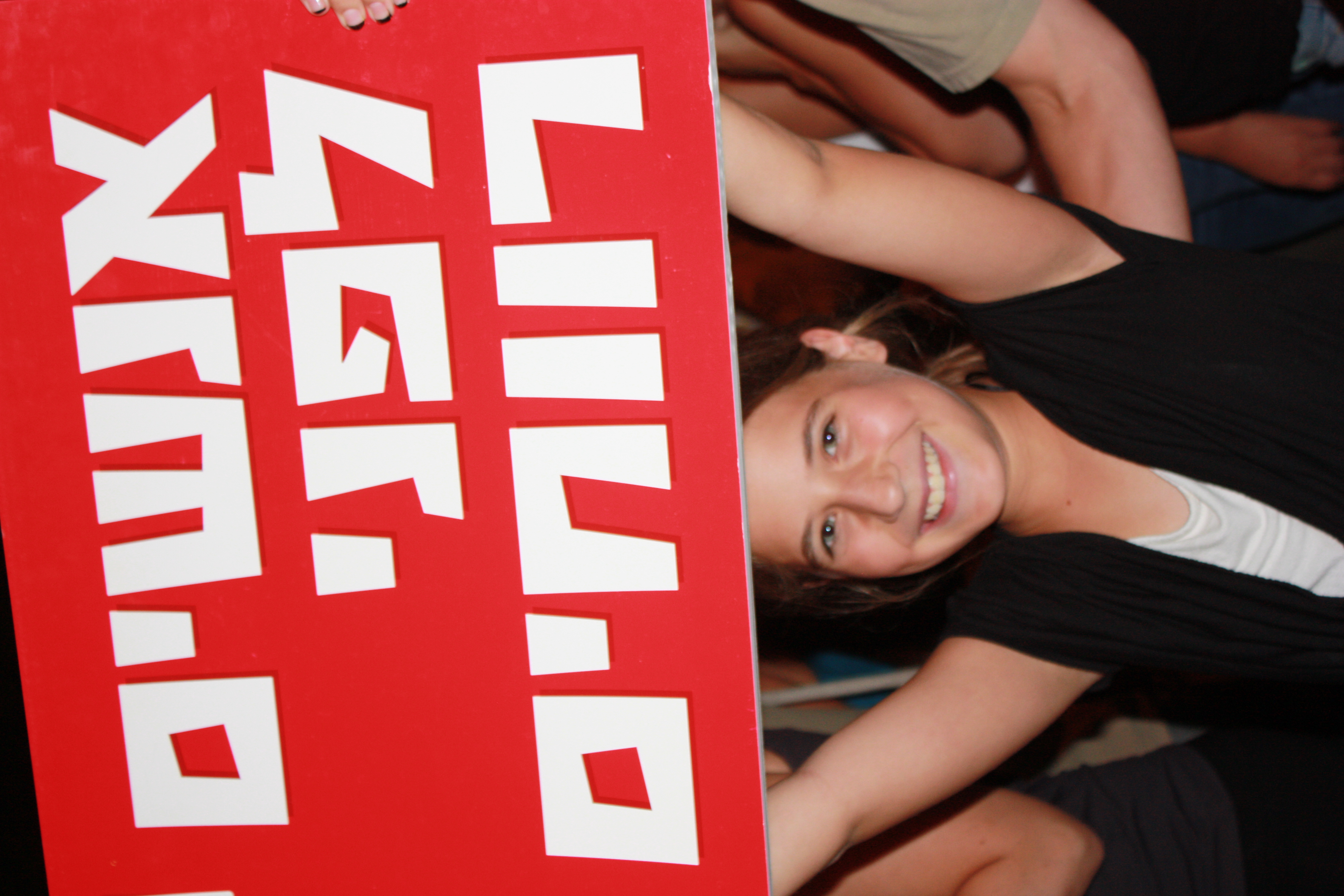
Jerusalem parents stroll for change

This sounds like a fabulous demonstration!

Jerusalem parents stroll for change

Thousands of children and their young fathers and mothers marched through the capital’s streets on Sunday evening, in a call to reduce living costs and enable them a decent future in the city and the country.

Departing from the Prime Minister’s Residence, where there was a large rally on the same theme the previous night, the families strolled down to King George Avenue’s Gan Hasus (Horse Park), where Jerusalem’s central protest tent city is located. Others have sprung up around the city.

According to police, a thousand adults took part in Sunday’s march....

The children and parents were then treated to storytelling by two of the country’s foremost authors. Meir Shalev read his story about The Tractor and the Sandbox, making minor alterations to change the protagonist tractor into the overworked Israeli middle class. David Grossman then captivated the audience with his story about a boy called Itamar who was afraid of rabbits.

To wrap things up, singer-songwriter-guitarist David Broza provided the thrilled parents and children with a passionate serving of some of the children classics he wrote and performed from his stellar The Sixteenth Sheep album, as well as more of his songs, including a reworked hit he and Yehonatan Geffen wrote 34 years ago, “Yihiye Tov” (Things Will Get Better), with the words updated to suit the spirit of the times and the protest.

ZEG

In his latest offering, conservative Australian cartoonist ZEG mocks the insincerity of Leftist "protesters"

For overseas readers, the mask in the toon is a caricature of John Howard, Australia's most recent conservative Prime Minister


Everybody forced to pay for flood insurance even though most are not in flood affected areas?

Insurance is already a major cost item for many -- and people living in flood affected areas get their houses very cheaply so surely they could afford to pay for their own flood insurance

EVERY Queensland household could be forced to pay higher premiums or taxes to subsidise insurance cover for people in flood-prone areas.

A federal insurance review panel - established in the wake of Queensland's summer of disasters - is set to recommend policyholders, taxpayers or ratepayers fork out more money to help make insurance more affordable for "high-risk" households.

The proposed hike comes as Premier Anna Bligh prepares to hand down the Holmes Flood Commission of Inquiry's draft report into the floods and Cyclone Yasi tomorrow. The twin disasters left Queensland with a $6.8 billion damage bill.

The head of the Federal Government's independent Natural Disaster Review Panel, John Trowbridge, admitted the proposal was unlikely to be popular.

"If it came all from insurance policyholders then basically you might have to pay $20 to $30 on top of your premiums to cover the risk for the high-flood ones," he said. "If it were ratepayers, then your council rates may be $20 or $30-a-year higher."

Asked how a proposal would be sold to the public, Mr Trowbridge said, "that's an interesting question. In a sense, that's a dilemma".

The review, to be handed to Assistant Treasurer Bill Shorten by the end of September, was sparked after concerns about the availability and affordability of insurance following Queensland's twin flood and cyclone disasters.

"There needs to be a way of dealing with the high-risk properties and that's probably going to involve some form of discount to people with a higher-risk property, or at least some of the people," Mr Trowbridge told The Sunday Mail.

Households with flood-prone properties would still pay more for insurance than those in low-risk areas, but they would receive a discount to help make their premiums more affordable.

It could encourage households not to opt out of insurance and would leave taxpayers with a smaller damage bill after the next natural disaster.

"One of the challenges ... is to figure out when we say it's (insurance) affordable and where we put them (high-risk property owners) into the scheme," he said.

SOURCE


Church school bans lesbian partners

STUDENTS at a leading Perth girls school have launched a campaign for the right to bring same-sex partners to their school formal.

A group of more than 40 past and present St Mary's Anglican Girls School students have confronted school authorities and started a Facebook campaign to argue for better gay rights. But they say school bosses are refusing to back down and have told them that bringing a same-sex partner to the school ball is "inappropriate".

WA Equal Opportunity Commissioner Yvonne Henderson said the school could be breaching the Equal Opportunities Act by discriminating on the basis of sexual orientation.

Kia Groom, 24, who graduated from St Mary's in 2003 is leading the campaign. She said she formed the online group St Mary's Anglican Girls School Diversity this month. She said "there are students at the school who don't feel comfortable" and the school policy was "damaging".

Other former students claimed the school chaplain, who is a member of the Facebook group and supported acceptance of gay students, was fired for being "too different" and "open-minded".

St Mary's declined to answer questions when contacted several times this week.

Ms Groom said gay rights had been raised many times at the school and each year students had elected representatives to approach the principal about bringing same-sex partners to the formal. And each year they were denied. Students were now determined to change the policy ahead of the next formal early next year. "To me that is just unacceptable and it just shocked me ... there was no further explanation as to why," Ms Groom said.

"As a result, my school ball experience was fairly sub-par because I didn't get to spend the night with who I wanted to ... the whole thing was tarnished."

Ms Groom, who is bisexual, said coming to terms with her sexuality was made more difficult by the school. She said it tried to "nip lesbian behaviour in the bud".

Association of Independent Schools of WA executive director Valerie Gould said schools could make their own policies.

The Education Department said it supported healthy growth and development of students and ensured people were treated fairly in public schools.

But Ms Yvonne Henderson said though there were some exceptions for religious schools, anyone had the right to lodge a complaint if they felt they had been treated "less favourably". "Our stance is the Act and the Act makes it quite clear that it is unlawful," she said.

Gay and Lesbian Equality WA co-convenor Kitty Hawkins said other public and private schools had similar policies. Some public school students were required to meet school heads to "prove they were gay" or in a same-sex relationship before being allowed to bring a same-sex partner.

"I understand that many single-sex schools wish to foster environments where they are able to mix with other genders, but this is still an inadequate reason (to exclude same-sex couples)," she said. "Same-sex attraction and trans-genderism are not contagious and allowing one or two same-sex couples to attend a dance together will not insinuate that the entire year will then follow suit."

Ms Hawkins said same-sex couples and trans-gendered students were bullied and teased, which often led to mental illness, self-harm, substance abuse and even suicide. "Schools public or private have an obligation towards their students to ensure that they are able to learn within an environment that is safe, respectful and accepting," she said. "To bar same-sex couples from a dance sends a strong message. For a young person in such an environment, this can be devastating."

SOURCE


Grazing and farming land taken over to offset carbon

FARMERS fear a new rush of environmental plantings for biodiversity and carbon offsets will accelerate the loss of land for food production.

In an emerging trend, carbon traders are starting to buy farms to generate carbon credits for sale under voluntary schemes or - assuming legislation clears the Senate - the federal government's Carbon Farming Initiative.

Storing carbon dioxide through reforestation and other techniques such as soil carbon opens up a potentially vast new market opportunity for rural Australia. The president of the NSW Farmers Federation, Fiona Simson, said while farmers supported the CFI, "carbon farming with a focus on forestry plantations is just another land-use conflict that's going to take land away from food production".

The first acquisition linked to the CFI occurred last week. The federal government and R.M. Williams Agricultural Holdings combined to pay $13 million for Henbury Station in the Northern Territory outback, to be transformed into the world's largest carbon farm.

In NSW the value of land bought by carbon traders for carbon offsets in 2010-11 was tiny: the Herald has confirmed one sale last year, of a 1700-hectare sheep and grain farm, Lorraine at Tullamore, in the state's far west, to the stock exchange-listed CO2 Group and utility ACTEW Corporation.

The chief executive of CO2 Group, Andrew Grant, said the property was marginal farming land and had been planted with blue leaf mallee eucalypt, a species endemic to the region. Reforestation was a priority for combating dry land salinity and restoring catchment health.

Mr Grant said his company, which managed 16,000 hectares across three states - almost half the 40,000 hectares under carbon forestry nationally - did not set out to own land and only bought when it had offset contracts to honour. "We don't prospect, we don't land bank," he said.

Robert Gill, who sold Lorraine, said he was nearing retirement age and his son was entrenched in another career. He had his merino sheep and cereal farming operation on the market for a few years before getting an offer near market price from CO2 Group. "There were not too many buyers about. I felt if I let these people go I might not find another buyer for a while."

However, Mr Gill said the farm was still productive and he was sad to see it go under trees after spending his "whole lifetime cleaning it up". "I'm very sceptical about the whole thing, to be honest," he said.

Where mining projects threaten endangered species, governments can require mining companies to buy land with biodiversity value to offset any impact. These acquisitions, worth almost $33 million, were a significant portion of the Herald's review of land sales in 2010-11.

In February, the Rio Tinto subsidiary Coal & Allied paid $23.4 million for a 9956-hectare stretch of land between Merriwa and Cassilis in the Upper Hunter, including the St Antoine grazing property owned by the cattleman Tony Maurici's Castlebar Holdings. Coal & Allied has confirmed these acquisitions would not be mined but were bought as biodiversity offsets as a condition for expanding mining in the Hunter.

In a presentation to investors last week the company said it had spent $40 million this year on offset acquisitions linked to its proposed Mount Pleasant coalmine near Muswellbrook. The Swiss miner Xstrata has also joined in, paying more than $8.4 million through the property agent Brunskill Pty Ltd for a series of farms in the Muswellbrook area, totalling 4419 hectares.

This payment was omitted from the Herald's Saturday story which reviewed mining purchases across the state; its inclusion pushes mining purchases above $120 million.

SOURCE


Values in dispute: secularism and tolerance in Australian education

By theologian Joel Hodge

Religious education in schools remains a vexed question for our society that no longer knows what to believe - or perhaps knows too well what it believes (or at least, certain sections of the population do), particularly as some turn towards more activist forms of agnosticism and atheism. For example, in Victoria, certain groups, including The Age, continue to protest against religious education in its present form (e.g., The God Complexity, The Age, 24/7).

These "secular" or atheist groups are arrayed against religious education for various reasons. Some of these reasons coalesce around certain arguments, particularly to do with tolerance and secularism. Since these groups and The Age rarely define tolerance and secularism in any depth, it might be worth reflecting on the use of these terms for the current debate. I will give a succinct rendition of these arguments, and analyse the problems with these arguments.

Firstly, tolerance: it is argued that Australia is a multi-religious, multicultural society that should not impose certain religious beliefs on people, but should be tolerant of different beliefs, with the implication that different religions should be studied alongside each other. The first point that one should note about this argument is that it is a belief: tolerance is a belief and value that structures how we see and behave toward each other. No-one can scientifically prove tolerance to be a valid or fool-proof way of running a society. Certain facts can be argued in its favour, but in the end, it can only be believed as a good and fruitful way of relating and acting (as it is in the West, though not necessarily in other places). I personally believe that tolerance can be a positive force in some circumstances, though it is not enough to have a successful society. Tolerance often sounds more like forbearance to me, rather than real acceptance of and engagement with the other.

The second point that one can notice about modern tolerance is that it is a belief that subjects other beliefs to it. In other words, it equalises different beliefs or social forces by subjecting them to its form of belief. In the case of "religion", it subjects the more prevalent forms (such as Christianity) to itself in order to control them, and then, equalise them with smaller forms. It may just to give smaller belief systems a chance to profess what they believe. This is not what modern tolerance is only about, however. It involves a power-play by the dominant elite to subject those social movements and beliefs to itself.

This second point, then, leads to my third point: tolerance is usually not real tolerance in our society, and because of this, we apply tolerance selectively for particular gain. For example, in the realm of sport, we allow many different sporting expressions in Australian society, however we do not reduce the more dominant forms, such as AFL, to the level of the less popular forms, such as bowling or synchronised swimming, by giving them the same media exposure or forcing children to learn and play them, out of tolerance. If we did, we would probably have widespread civil unrest. Real tolerance is not subjecting everything to the same playing field, but allowing different religious and cultural forms to exist in their own way. Do we really do this in Australian society? Do we really allow different religio-cultural forms, such as New Zealanders, or Hinduis, or Arabic cultures, to exist in their own form? No, because there's an existing culture, language, belief system, and way of life in Australia to which other cultural forms adapt themselves.

Therefore, for the religious education debate, the argument about tolerance can be seen as a ruse to subject a certain dominant belief system (Christianity) to another, atheist secularism. Modern secularism has no great respect for different religious forms, but wishes to equalise and subject all of them to its agenda. This does not mean that "religion" can't be studied in some form in schools. I think it should, but we should be clear what religion is: it is not just Christianity or Islam, but involves studying all belief systems that structure how we think about ourselves and how we act toward each other, which could include forms of modern secularism, nationalism and sport.

Now to the second term that is used widely in the "religious education" debate: secularism. We are repeatedly told that we live in a secular society and that our education system is secular. Yet, the term "secular" is rarely defined. Often it is used to mean "anti-religion" (which really means certain forms of religion such as Christian) or "anti-sectarianism". Professor Peter Sherlock has given a short and insightful history of the debate over Christian education and secularism in Victoria schools (on the ABC religion & ethics page) that might help some to have a better appreciation of the complex history of this debate.

The way that secular is used in modern Australia usually means the exclusion of religion, specifically Christianity. Yet, the problem with this argument is that there is no way to properly define religion to the exclusion of other belief systems, such as nationalism, capitalism or sport. Furthermore, secular has not always meant "anti-religion". In some sense, it has meant the carving out of a space in which politics and religion are separate. However, we should note that in modern times the state took on particular powers in doing this, and over time, this has meant other incipient belief systems have taken over education and culture, such as forms of nationalism.

The final point to make in regards to this "secular" push is that it sees itself as defending a certain secular legacy against religious aggressiveness, which should not be allowed in the public realm. For example, the Christian educators in schools are made out by certain media agencies to be radical proselytisers imposing their beliefs on children. While this can happen, this kind of argument is unjust to the ordinary people trying to positively contribute to Australian society by affirming that children are loved, not just by imperfect humans but by their maker, God. Furthermore, it is a straw argument constructed to make out religious people as aggressors and secular people as righteous defenders. This kind of conflictual dualism is unhelpful to the debate and should be abandoned.

The defensiveness of certain groups in the religious education debate seems ultimately to do with the beliefs and values underlying Australian society. Each side to this debate has beliefs and values they wish to put forward, and we should be honest about this. Though this is not always the case, one of the problems with the state education system, as John Howard intimated, can be the lack of coherent and consistent beliefs and values that provide a foundation for children and society. This problem is an element in this debate that people often ignore (and contributes to the defensiveness of some). Christian churches (and others) have defined values that they offer, to which many parents are increasingly attracted as is shown by the growth in Christian schools and support for religious education (which, by the way, makes The Age's argument about moderate Christians turning against religious education dubious).

Nevertheless, some of the fear of Christian beliefs should also be better dispelled by Christians because, while Christianity does provide an over-arching framework for understanding our lives, it is not (and should not be) a closed system. God is often taken as the final answer, but God is just the beginning of a journey into the mystery of existence; one that Christians profess has to do with an open and affirming love which can orient us, but not control or overwhelm our freedom.

Therefore, we need to examine our beliefs in this debate much more deeply and not use smokescreens to cover our real intentions and agendas. In this way, we might be able to find common ground.

SOURCE


Note: I have two other blogs covering Australian news. They are more specialized so are not updated daily but there are updates on both most weeks. See QANTAS/Jetstar for news on Qantas failings and Australian police news for news on police misbehaviour

ZEG

In his latest offering, conservative Australian cartoonist ZEG mocks the insincerity of Leftist "protesters"

For overseas readers, the mask in the toon is a caricature of John Howard, Australia's most recent conservative Prime Minister


Everybody forced to pay for flood insurance even though most are not in flood affected areas?

Insurance is already a major cost item for many -- and people living in flood affected areas get their houses very cheaply so surely they could afford to pay for their own flood insurance

EVERY Queensland household could be forced to pay higher premiums or taxes to subsidise insurance cover for people in flood-prone areas.

A federal insurance review panel - established in the wake of Queensland's summer of disasters - is set to recommend policyholders, taxpayers or ratepayers fork out more money to help make insurance more affordable for "high-risk" households.

The proposed hike comes as Premier Anna Bligh prepares to hand down the Holmes Flood Commission of Inquiry's draft report into the floods and Cyclone Yasi tomorrow. The twin disasters left Queensland with a $6.8 billion damage bill.

The head of the Federal Government's independent Natural Disaster Review Panel, John Trowbridge, admitted the proposal was unlikely to be popular.

"If it came all from insurance policyholders then basically you might have to pay $20 to $30 on top of your premiums to cover the risk for the high-flood ones," he said. "If it were ratepayers, then your council rates may be $20 or $30-a-year higher."

Asked how a proposal would be sold to the public, Mr Trowbridge said, "that's an interesting question. In a sense, that's a dilemma".

The review, to be handed to Assistant Treasurer Bill Shorten by the end of September, was sparked after concerns about the availability and affordability of insurance following Queensland's twin flood and cyclone disasters.

"There needs to be a way of dealing with the high-risk properties and that's probably going to involve some form of discount to people with a higher-risk property, or at least some of the people," Mr Trowbridge told The Sunday Mail.

Households with flood-prone properties would still pay more for insurance than those in low-risk areas, but they would receive a discount to help make their premiums more affordable.

It could encourage households not to opt out of insurance and would leave taxpayers with a smaller damage bill after the next natural disaster.

"One of the challenges ... is to figure out when we say it's (insurance) affordable and where we put them (high-risk property owners) into the scheme," he said.

SOURCE


Church school bans lesbian partners

STUDENTS at a leading Perth girls school have launched a campaign for the right to bring same-sex partners to their school formal.

A group of more than 40 past and present St Mary's Anglican Girls School students have confronted school authorities and started a Facebook campaign to argue for better gay rights. But they say school bosses are refusing to back down and have told them that bringing a same-sex partner to the school ball is "inappropriate".

WA Equal Opportunity Commissioner Yvonne Henderson said the school could be breaching the Equal Opportunities Act by discriminating on the basis of sexual orientation.

Kia Groom, 24, who graduated from St Mary's in 2003 is leading the campaign. She said she formed the online group St Mary's Anglican Girls School Diversity this month. She said "there are students at the school who don't feel comfortable" and the school policy was "damaging".

Other former students claimed the school chaplain, who is a member of the Facebook group and supported acceptance of gay students, was fired for being "too different" and "open-minded".

St Mary's declined to answer questions when contacted several times this week.

Ms Groom said gay rights had been raised many times at the school and each year students had elected representatives to approach the principal about bringing same-sex partners to the formal. And each year they were denied. Students were now determined to change the policy ahead of the next formal early next year. "To me that is just unacceptable and it just shocked me ... there was no further explanation as to why," Ms Groom said.

"As a result, my school ball experience was fairly sub-par because I didn't get to spend the night with who I wanted to ... the whole thing was tarnished."

Ms Groom, who is bisexual, said coming to terms with her sexuality was made more difficult by the school. She said it tried to "nip lesbian behaviour in the bud".

Association of Independent Schools of WA executive director Valerie Gould said schools could make their own policies.

The Education Department said it supported healthy growth and development of students and ensured people were treated fairly in public schools.

But Ms Yvonne Henderson said though there were some exceptions for religious schools, anyone had the right to lodge a complaint if they felt they had been treated "less favourably". "Our stance is the Act and the Act makes it quite clear that it is unlawful," she said.

Gay and Lesbian Equality WA co-convenor Kitty Hawkins said other public and private schools had similar policies. Some public school students were required to meet school heads to "prove they were gay" or in a same-sex relationship before being allowed to bring a same-sex partner.

"I understand that many single-sex schools wish to foster environments where they are able to mix with other genders, but this is still an inadequate reason (to exclude same-sex couples)," she said. "Same-sex attraction and trans-genderism are not contagious and allowing one or two same-sex couples to attend a dance together will not insinuate that the entire year will then follow suit."

Ms Hawkins said same-sex couples and trans-gendered students were bullied and teased, which often led to mental illness, self-harm, substance abuse and even suicide. "Schools public or private have an obligation towards their students to ensure that they are able to learn within an environment that is safe, respectful and accepting," she said. "To bar same-sex couples from a dance sends a strong message. For a young person in such an environment, this can be devastating."

SOURCE


Grazing and farming land taken over to offset carbon

FARMERS fear a new rush of environmental plantings for biodiversity and carbon offsets will accelerate the loss of land for food production.

In an emerging trend, carbon traders are starting to buy farms to generate carbon credits for sale under voluntary schemes or - assuming legislation clears the Senate - the federal government's Carbon Farming Initiative.

Storing carbon dioxide through reforestation and other techniques such as soil carbon opens up a potentially vast new market opportunity for rural Australia. The president of the NSW Farmers Federation, Fiona Simson, said while farmers supported the CFI, "carbon farming with a focus on forestry plantations is just another land-use conflict that's going to take land away from food production".

The first acquisition linked to the CFI occurred last week. The federal government and R.M. Williams Agricultural Holdings combined to pay $13 million for Henbury Station in the Northern Territory outback, to be transformed into the world's largest carbon farm.

In NSW the value of land bought by carbon traders for carbon offsets in 2010-11 was tiny: the Herald has confirmed one sale last year, of a 1700-hectare sheep and grain farm, Lorraine at Tullamore, in the state's far west, to the stock exchange-listed CO2 Group and utility ACTEW Corporation.

The chief executive of CO2 Group, Andrew Grant, said the property was marginal farming land and had been planted with blue leaf mallee eucalypt, a species endemic to the region. Reforestation was a priority for combating dry land salinity and restoring catchment health.

Mr Grant said his company, which managed 16,000 hectares across three states - almost half the 40,000 hectares under carbon forestry nationally - did not set out to own land and only bought when it had offset contracts to honour. "We don't prospect, we don't land bank," he said.

Robert Gill, who sold Lorraine, said he was nearing retirement age and his son was entrenched in another career. He had his merino sheep and cereal farming operation on the market for a few years before getting an offer near market price from CO2 Group. "There were not too many buyers about. I felt if I let these people go I might not find another buyer for a while."

However, Mr Gill said the farm was still productive and he was sad to see it go under trees after spending his "whole lifetime cleaning it up". "I'm very sceptical about the whole thing, to be honest," he said.

Where mining projects threaten endangered species, governments can require mining companies to buy land with biodiversity value to offset any impact. These acquisitions, worth almost $33 million, were a significant portion of the Herald's review of land sales in 2010-11.

In February, the Rio Tinto subsidiary Coal & Allied paid $23.4 million for a 9956-hectare stretch of land between Merriwa and Cassilis in the Upper Hunter, including the St Antoine grazing property owned by the cattleman Tony Maurici's Castlebar Holdings. Coal & Allied has confirmed these acquisitions would not be mined but were bought as biodiversity offsets as a condition for expanding mining in the Hunter.

In a presentation to investors last week the company said it had spent $40 million this year on offset acquisitions linked to its proposed Mount Pleasant coalmine near Muswellbrook. The Swiss miner Xstrata has also joined in, paying more than $8.4 million through the property agent Brunskill Pty Ltd for a series of farms in the Muswellbrook area, totalling 4419 hectares.

This payment was omitted from the Herald's Saturday story which reviewed mining purchases across the state; its inclusion pushes mining purchases above $120 million.

SOURCE


Values in dispute: secularism and tolerance in Australian education

By theologian Joel Hodge

Religious education in schools remains a vexed question for our society that no longer knows what to believe - or perhaps knows too well what it believes (or at least, certain sections of the population do), particularly as some turn towards more activist forms of agnosticism and atheism. For example, in Victoria, certain groups, including The Age, continue to protest against religious education in its present form (e.g., The God Complexity, The Age, 24/7).

These "secular" or atheist groups are arrayed against religious education for various reasons. Some of these reasons coalesce around certain arguments, particularly to do with tolerance and secularism. Since these groups and The Age rarely define tolerance and secularism in any depth, it might be worth reflecting on the use of these terms for the current debate. I will give a succinct rendition of these arguments, and analyse the problems with these arguments.

Firstly, tolerance: it is argued that Australia is a multi-religious, multicultural society that should not impose certain religious beliefs on people, but should be tolerant of different beliefs, with the implication that different religions should be studied alongside each other. The first point that one should note about this argument is that it is a belief: tolerance is a belief and value that structures how we see and behave toward each other. No-one can scientifically prove tolerance to be a valid or fool-proof way of running a society. Certain facts can be argued in its favour, but in the end, it can only be believed as a good and fruitful way of relating and acting (as it is in the West, though not necessarily in other places). I personally believe that tolerance can be a positive force in some circumstances, though it is not enough to have a successful society. Tolerance often sounds more like forbearance to me, rather than real acceptance of and engagement with the other.

The second point that one can notice about modern tolerance is that it is a belief that subjects other beliefs to it. In other words, it equalises different beliefs or social forces by subjecting them to its form of belief. In the case of "religion", it subjects the more prevalent forms (such as Christianity) to itself in order to control them, and then, equalise them with smaller forms. It may just to give smaller belief systems a chance to profess what they believe. This is not what modern tolerance is only about, however. It involves a power-play by the dominant elite to subject those social movements and beliefs to itself.

This second point, then, leads to my third point: tolerance is usually not real tolerance in our society, and because of this, we apply tolerance selectively for particular gain. For example, in the realm of sport, we allow many different sporting expressions in Australian society, however we do not reduce the more dominant forms, such as AFL, to the level of the less popular forms, such as bowling or synchronised swimming, by giving them the same media exposure or forcing children to learn and play them, out of tolerance. If we did, we would probably have widespread civil unrest. Real tolerance is not subjecting everything to the same playing field, but allowing different religious and cultural forms to exist in their own way. Do we really do this in Australian society? Do we really allow different religio-cultural forms, such as New Zealanders, or Hinduis, or Arabic cultures, to exist in their own form? No, because there's an existing culture, language, belief system, and way of life in Australia to which other cultural forms adapt themselves.

Therefore, for the religious education debate, the argument about tolerance can be seen as a ruse to subject a certain dominant belief system (Christianity) to another, atheist secularism. Modern secularism has no great respect for different religious forms, but wishes to equalise and subject all of them to its agenda. This does not mean that "religion" can't be studied in some form in schools. I think it should, but we should be clear what religion is: it is not just Christianity or Islam, but involves studying all belief systems that structure how we think about ourselves and how we act toward each other, which could include forms of modern secularism, nationalism and sport.

Now to the second term that is used widely in the "religious education" debate: secularism. We are repeatedly told that we live in a secular society and that our education system is secular. Yet, the term "secular" is rarely defined. Often it is used to mean "anti-religion" (which really means certain forms of religion such as Christian) or "anti-sectarianism". Professor Peter Sherlock has given a short and insightful history of the debate over Christian education and secularism in Victoria schools (on the ABC religion & ethics page) that might help some to have a better appreciation of the complex history of this debate.

The way that secular is used in modern Australia usually means the exclusion of religion, specifically Christianity. Yet, the problem with this argument is that there is no way to properly define religion to the exclusion of other belief systems, such as nationalism, capitalism or sport. Furthermore, secular has not always meant "anti-religion". In some sense, it has meant the carving out of a space in which politics and religion are separate. However, we should note that in modern times the state took on particular powers in doing this, and over time, this has meant other incipient belief systems have taken over education and culture, such as forms of nationalism.

The final point to make in regards to this "secular" push is that it sees itself as defending a certain secular legacy against religious aggressiveness, which should not be allowed in the public realm. For example, the Christian educators in schools are made out by certain media agencies to be radical proselytisers imposing their beliefs on children. While this can happen, this kind of argument is unjust to the ordinary people trying to positively contribute to Australian society by affirming that children are loved, not just by imperfect humans but by their maker, God. Furthermore, it is a straw argument constructed to make out religious people as aggressors and secular people as righteous defenders. This kind of conflictual dualism is unhelpful to the debate and should be abandoned.

The defensiveness of certain groups in the religious education debate seems ultimately to do with the beliefs and values underlying Australian society. Each side to this debate has beliefs and values they wish to put forward, and we should be honest about this. Though this is not always the case, one of the problems with the state education system, as John Howard intimated, can be the lack of coherent and consistent beliefs and values that provide a foundation for children and society. This problem is an element in this debate that people often ignore (and contributes to the defensiveness of some). Christian churches (and others) have defined values that they offer, to which many parents are increasingly attracted as is shown by the growth in Christian schools and support for religious education (which, by the way, makes The Age's argument about moderate Christians turning against religious education dubious).

Nevertheless, some of the fear of Christian beliefs should also be better dispelled by Christians because, while Christianity does provide an over-arching framework for understanding our lives, it is not (and should not be) a closed system. God is often taken as the final answer, but God is just the beginning of a journey into the mystery of existence; one that Christians profess has to do with an open and affirming love which can orient us, but not control or overwhelm our freedom.

Therefore, we need to examine our beliefs in this debate much more deeply and not use smokescreens to cover our real intentions and agendas. In this way, we might be able to find common ground.

SOURCE


Note: I have two other blogs covering Australian news. They are more specialized so are not updated daily but there are updates on both most weeks. See QANTAS/Jetstar for news on Qantas failings and Australian police news for news on police misbehaviour

‘The State Is Responsible for the Well-Being of Its Citizens’

Gershom Gorenberg reports on the demands of the leaders of the tent protests, which they made at a press conference today: ‘The State Is Responsible for the Well-Being of Its Citizens’. This is after the 150,000 Israelis they brought to the streets last night.

The demands, as laid out by Stav Saphir:
Last night at the rally we declared our demands, what we define as social justice. These demands are actually dreams more than demands – but all these are dreams that can be made real and turn this country into a country of social [responsibility], in which it will be good for all of us to live.

Housing: A home is not just real estate. The state must intervene, immediately, in the housing market to defend the citizens. We demand decent housing for all via construction of state-owned housing… The state must regulate rent and rental conditions.

Education: A school isn’t a business. We demand a free, egalitarian school system throughout the country – for the religious and the secular, for Jews and Arabs, for everyone. We demand free public education from age zero and assistance for those who need it to pursue higher education.

Health care: We identify with the struggle of the doctors, deeply identify with their struggle, and join in all of their justified demands. We’d demand even more. They deserve more. We deserve more. It’s our health.

Social welfare: The state must be responsible for the well-being of the citizens. This is not the job of non-profits and voluntary organizations. In particular, the state must provide for social workers, police, firefighters, teachers and all others who dedicate their lives to protecting, caring for and defending the entire public.

Fair wages: Contract labor, temporary employment and personal contracts are only some of the evils that have become endemic and deprive many citizens of their most basic rights. The state must make sure that pay is commensurate with the cost of living, and must increase enforcement of labor law.

Those are our demands. We expect them to be accepted as quickly as possible. This is the country that we want to live in.
That's the country that I want to live in too! The idea that "the state must be responsible for the well-being of the citizens" is one of the principles that the state of Israel was built on by its Labor founders, and which has been lost over the last 25 years. Would that the leaders of the United States would also take heed of this principle, rather than squabbling among themselves about how much more to cut from Social Security, Medicare, Medicaid, aid to education, and all the other social responsibilities of government, in order to guarantee still lower tax rates to rich people and corporations. The United States needs an Arab Spring also!

Photos from the Israeli protests

I'm looking through a series of photos that Haaretz photographers have taken of the protests, and the first ones are from July 14 - when I was still in Israel (I left on the 17th). I had thought the protests started immediately after I left (oddly enough, the second Lebanon War in 2006 started two days after I left the country....). The first photos are of tents being erected on Rothschild Boulevard in Tel Aviv on July 14.

Some striking ones (to me): one from 7/17/11 in Beersheva, showing an ultra-Orthodox father and his children setting up a protest tent; one from 7/19/11 in Kiryat Shmona (a poor development town in the north), showing a small encampment of tents; another from the same date, showing tents in Tamra, an Arab town in the Galilee; 7/20/11 - protests tents in Jerusalem, just outside the walls of the Old City; a demonstration in Jerusalem on 7/25/11 that blocks Kikar Paris, with people being dragged away by they police. I remember Kikar Paris well from the first intifada, when Women in Black and Dai la-Kibush held frequent demonstrations there. Also from 7/25/11, a march in Beersheva, with a woman holding a sign that reads "the monster of the mortgages."

On Rothschild Boulevard in Tel Aviv, posters are put up with the names of the few wealthy individuals and families who now own the most of Israel:  David Weissman/Shraga Biran - owners of Dor Alon, Alon Energy, Rosebud Real Estate. David Azrieli - owner of Garnit ha-Carmel Investments, the Azrieli Malls, Globus movie theaters, Sonol gas stations, Bank Leumi. Isaac Teshuvah (gasoline companies) - owner of the Phoenix (investments), Delek Real Estate, Delek Cars - importer of Mazda and Ford, Delek Energy - Gas and Oil, Delek Israel - gas stations. Ofer Family - Israel Company, owning Bank Mizrahi Tefahot, Israeli Chemicals, Ofer Ships, Zim.

From 7/26/11 - a photo of a protest march in Haifa, with signs in Hebrew and Arabic, and people carrying Israeli flags and tents. From the same night - the protest march blocking the street, with one sign held high - "We were slaves to Pharaoh in Egypt, and today to the State of Israel." Also from the 26th, a photo of tents in Independence Park in Jerusalem, with a giant picture of Bib's face strung up above them. From 7/27/11 - a photo of a sign hung up on the Prime Minister's house in Jerusalem: "House for Sale. 5 Million shekels. For details - Bibi." The last few photos are of the "stroller protest" in Tel Aviv on 7/28/11 (I'm not sure what that is - I haven't yet read the articles about it).

Israel protest news

Now, would this ever happen in America? No. Of course, I've never seen this happen in Israel either, although there certainly have been general strikes before.

Most Israeli municipalities declare general strike in solidarity with housing protests
Most municipal authorities have declared a one-day strike scheduled for Monday, in sympathy with popular protests spreading throughout Israel.
Municipalities will not be giving services to government offices or holding public office hours today, streets will not be cleaned and garbage will not be collected.
Israeli settlers largely back the housing protests but are wary of left-wing slant.
After two weeks of front-page headlines about demonstrations over the high cost of housing, Yehuda Shimon - a lawyer from the West Bank Jewish settlement outpost of Havat Gilad - decided on Thursday that the time had come for him to visit Tel Aviv himself for a firsthand look at the tent city on Rothschild Boulevard. As an expert in the never-ending struggle over the unauthorized Havat Gilad outpost, Shimon thought he might be able to learn a thing or two from the Tel Aviv demonstrators.
After surveying the scene, Shimon returned to Havat Gilad disappointed. Calling the protest tent encampment "one big, despicable summer camp," Shimon proclaimed that the tent city was not a genuine protest; his impression was that most of the protesters seemed to have come out of mere summer boredom. "Once the boredom passes, this whole battle will die out," Shimon predicted.

Yet even as Shimon spoke, his wife Ilana challenged his remarks.
"The protest is justified," she said. "You can't raise children in this country."
The difference of opinion between Yehuda Shimon and his wife appears to be a reflection of wider sentiments among residents of the West Bank settlements. On one hand, they agree that the burden on the public must be eased. On the other, they see the current housing protests as an effort by left-wing activists to piggyback on justified grievances in order to promote the broader diplomatic agenda of the left.
The power of Facebook in Israeli protests.
....the role of Facebook is not limited to news updates. The protesters on Rothschild Boulevard hold meetings where everyone can have a say. On Facebook, one status update can provoke a flood of responses and turn into a heated public debate.
Facebook is what radio was in the early days of the state, what television was when the Iron Curtain crumbled, what the newspapers were during the Spring of Nations. The protests over the price of gas, cottage cheese and, of course, housing, would not have accelerated as they did without Facebook.
It's even possible that without this platform, where people can call for a boycott and get infinitely more exposure for their views than they would by standing in the town square, these protests would have never taken place.

Why are Israelis protesting for social justice?

When I was in Israel earlier this summer, the big local protest was about the cost of cottage cheese, which had been raised greatly in the last 2-3 years. The protest was started on Facebook by a haredi man and eventually gained 100,000 signatures. The three big dairy companies in Israel finally conceded and lowered the price. But this was only symbolic of the increasing discontent with rising prices of food, real estate, and everything else. I've commented for several years to my friends in Israel that the only housing being built in Jerusalem seems to be extravagantly expensive developments that only rich people from outside of the country can afford to live in. This has created the phenomenon in the city of "ghost" neighborhoods - blocks of luxury apartments that are largely uninhabited for most of the year, when their wealthy foreign owners visit the city. 

I was talking to some new friends this summer - a young couple with two children, one working as a teacher's assistant in a school for severely handicapped children, the other working in construction (yes, there are Jewish Israelis working as construction workers) - but he recently quit that job and started one that probably pays quite a deal less, working as a clerk at a grocery story. My guess about their income is that they make around 7,000 shekels a month (=about $2000). They're living in a rented apartment, where I would guess the rent is around 2500-3000 shekels per month. The night I got together with them, they were discussing an apartment for sale that a friend had told them about - for 900,000 shekels (=about $264,000). Could they afford an apartment at that price?As a young couple, they could get some funding from the government, but that wouldn't cover very much, and they'd end up with an enormous mortgage, if a bank would lend to them.

It's the situation of people like them that is driving these protests.

Another significant development over the past years is the privatization of big parts of the Israeli economy that used to belong to the government. These companies now belong to enormously rich people (the "oligarchs" - like the Russian oligarchs who ended up dominating that economy after the fall of communism). After talking to some friends this summer, I finally grasped that this is one big reason why the gap between rich and poor has grown so immense in Israel. Israel is also a high-tech incubator, but that has also added to the increasing gap. Of all the countries in the Organization for Economic Cooperation and Development (which Israel just joined last year), Israel has the biggest gap.
..... the country is still at the bottom of the rankings. Every fifth Israeli is twice as poor as the average person in OECD member states. Most of the poor come from Arab and ultra-orthodox communities, where poverty rises to 50 percent and 60 percent, respectively. More than half of Israelis are paid less than NIS 4,000 a month, while only a very few make many times as much.
You don't hear much of this in the foreign press, or even the Jewish press in America - the economic stories I have read recently about Israel are all about the high-tech sector, leaving behind the more than half of Israelis who don't make more than $1200 per month.

"The people want social justice" - protests in Israel

Has the Arab Spring come to Israel? If you expect to learn about this by reading the New York Times or listening to NPR, you're out of luck - they haven't discovered the story yet. But fortunately we have some independent journalists from Israel reporting on something different from the usual hopeless Israel-Palestinian conflict stories.

My friend Gershom Gorenberg reports from Jerusalem:
The dead have come to life.
I saw them marching tonight through Jerusalem, jumping, swaying, pounding pots and water-cooler bottles as drums, the Israelis in their twenties who’d been written off in a thousand political obituaries as dead of terminal apathy, sweating in the absurd heat close to midnight, roaring so deep you could hear their throats tearing in anger and in joy at being angry together and being alive again.

'People before Profits'
‘People before Profits’ (Gershom Gorenberg)
They came flooding down from Zion Square through Independence Park and up Agron Street to the square outside of one of Netanyahu’s three homes, and they sang an old kindergarten song about “my hat has three corners” rewritten as “my Bibi owns three houses,” and they overflowed up onto the walls and fences past the sidewalks and they danced with mad happiness at seeing each other.

They chanted “The people want social justice!” and “What’s the answer to privatization? Re-Vo-Lu-Tion!” and waved flags, both blue-and-white and red. They cheered for the Arab medical student telling the government it has to pay for health care, and for the teacher decrying the pure insult of treating teachers as temp workers, and for the rabbi quoting Isaiah....

For those reading from abroad, I also note that so far, foreign editors have completely missed what’s happening here, because the stories they expect from Israel are about war and terror and peace talks, so they haven’t gotten their minds around two weeks of protests that just keep getting bigger, Israelis inspired by Egypt, demanding what was once the basic minimum here before the poison of privatization arrived: free education, free health care, affordable apartments.
Read the whole thing.

For more coverage, from +972: Marches for Social Justice in Israel.
Huge protests in cities across Israel signal they are a growing political force

The housing and social protests tonight reached a huge crescendo, with throngs flooding streets in over 10 cities across the country Israel. Haaretz is reporting roughly 150,000 people around the country in Hebrew (most conservative estimate in the morning papers belongs to the pro-Netanyahu free paper, Israel Hayom: 100,000 protesters).

Compared to the estimated 20,000 to 30,000 who demonstrated last week, the number of protesters around the country may have more than quadrupled.

In Tel Aviv, the roar of frenzied euphoria mixed with anger preceded the crowd as the parade rounded a major intersection on its way to the Tel Aviv museum. Screams of “revolution” were echoed all over the country. Estimates speak of 10,000 in Jerusalem, similar numbers in Haifa and Beer Sheva, along with demonstrations in Kiryat Shmona, Nazareth, Ashdod several other locations.

Like last week, the Tel Aviv demonstration ended with a large and loud sit-in at a major traffic intersection (Dizengoff and Kaplan streets); police formed human chains to block streets, mounted police appeared, and eventually called to break up the protesters. Eight were arrested and released in the following morning.

At first glance, it appeared that the crowd’s demands were not significantly different from last week. The main rallying cry was still: “The people! Want! Social justice!” with a generous dose of “Bibi go home,” as well as anti-capitalism, pro-welfare state slogans, all laced with dripping sarcasm along the lines of: “The market is free, but we’re slaves.”

Over the last two weeks, the protests have been criticized as unfocused and lacking concrete demands. Tonight there were new signs of a plan taking shape. In the final speeches, after a lineup that included celebrity musicians, the organizers wrapped up with several quite specific demands. In what sounded very much like an ultimatum, they said that Netanyahu has until Wednesday, the day the Knesset goes on recess, to do two things: Withdraw the pending law for national housing committees – which they consider deeply damaging  - and prevent the privatization of the Israel Lands Administration, which holds the vast majority of land in Israel.

On Sunday, Netanyahu has announced that a team of ministers would meet the representatives of the protest movement. The director of Israel’s finance ministry has resigned in the morning following the protest, citing the protest among his reasons.

Saturday, July 30, 2011

Light soon on Labor party coverup?

New light shed on Heiner Affair with 'Shreddergate' inquiry set to open. Could it be Kevvy who is being protected?

Annette McIntosh, 37, is one of the living victims of Shreddergate - a 20-year controversy involving politicians, shredded documents and "hush money".

For the first time, she has revealed her full identity in her fight for justice. Mrs McIntosh alleges that at 14 years old, as a ward of the state at Brisbane's John Oxley Detention Centre, she was pack-raped.

A year ago, the State Government paid Mrs McIntosh $140,000 in compensation for a crime that never led to charges, let alone an investigation.

She signed a confidentiality agreement. But that is about to be broken. Mrs McIntosh will head to Canberra when Federal Parliament resumes next month, and with Independent Senator Nick Xenophon will fight to open a new inquiry into what has been referred to as the Heiner Affair.

"I cannot wait. I have been waiting for this ... just to tell them straight out I'm still alive," Mrs McIntosh told The Sunday Mail.

"It feels good to speak because I've been told to shut my mouth for over 20 years."

Several probes have been held into the Heiner inquiry's investigation into alleged crimes at the detention centre.

Documents were shredded by the then Goss Government because of fears of legal problems relating to the inquiry, which was also disbanded. Foreign Affairs Minister Kevin Rudd was chief-of-staff to then premier Wayne Goss at the time of the shredding.

But an inquiry has never been held into why Mrs McIntosh, who works with indigenous youth, was paid compensation.

Moves for an inquiry were put on ice last month when former Family First senator Steve Fielding shocked Senator Xenophon and the Coalition by pulling his support.

HOW THE SAGA UNFOLDED

1989: Former magistrate Noel Heiner appointed by the then National Party to inquire into alleged abuse at the John Oxley Detention Centre

1990: Incoming Labor Goss government shreds documents over fears the inquiry was not properly constituted

1995: The Criminal Justice Commission cleared of allegations it had lied to a federal Senate inquiry about a whistleblower who provided information to the Heiner inquiry

1996: Barristers Tony Morris, QC, and Edward Hoard appointed by the Borbidge government to hold an investigation into the shredding

2004: Federal Senate select committee holds hearings into the shredding but they lead to no charges

2010: Alleged victim Annette McIntosh receives compensation from the Bligh Government

SOURCE


New $800 'green tax' mooted on homes - you must pay before you can sell

As if houses were not dear enough already!

EMBATTLED homeowners could be slugged more than $800 to give their houses a compulsory "green rating" before they are sold or leased, under a new federal government scheme.

Mandatory "green ratings" for apartments and houses similar to those on new washing machines and fridges are to be introduced in the initiative to encourage more energy efficient homes.

The ratings are part of the requirement for each state to introduce legislation requiring homeowners to disclose their home's energy, greenhouse and water efficiency when they advertise it for sale or lease.

A national report has posed four different options for energy audits which in NSW would range in price from about $200 to $820.

Public consultations on compulsory testing will be held for the first time around the country starting in Sydney on Tuesday.

The most expensive option detailed in the report estimates a charge to an individual home owner of $774 for an assessor with an added $50 cost for the inconvenience of having to arrange to be present during the assessment.

The most intensive of the options, it involves a thermal building assessment which gauges a property's heating and cooling efficiency and other components.

But homeowners would not benefit from this option, which is estimated to cost homeowners a total of $1.9 billion, Real Estate Institute of NSW president Wayne Stewart said. "We agree there needs to be a change of thought and attitude towards energy efficiency," Mr Stewart said. "But the government needs to work with consumers to bring about change rather than slap them with what looks like being another tax of up to $800."

A less expensive option involves a simpler thermal assessment, involving a cost of $172.50 for an assessor and a $25 cost to a householder.

The third model would be an online version of the thermal performance assessment at a cost of $68 if done by the householder or $165 if done by an assessor with an associated $18 "householder waiting cost".

The fourth option is similar to that already adopted in Queensland whereby a homeowner fills out a checklist of building information.

This option is estimated to cost $41 if done by the property owner and $150 if done by an assessor.

Mandatory energy ratings were being introduced to establish a credible and uniform system, a spokesperson for Department of Climate Change and Energy Efficiency said.

Rating a property's green performance could also boost its value. "Assessing the energy and water efficiency characteristics of a home can help people chose a property that is potentially more comfortable and cheaper to run," the spokesperson said.

SOURCE


Your regulators will protect you -- NOT

Dodgy Victorian doctors exposed

A Beaumaris doctor, who smoked ice and shot up pethidine with his patient and lover, is among dozens of disgraced doctors still registered to practise in Victoria. Supplied

BEAUMARIS doctor Sotirios Giokas, who smoked ice and shot up pethidine with his patient and lover, is among dozens of disgraced doctors still registered to practise in Victoria.

Thirty-three Victorian doctors - disciplined for sexual harassment of patients and staff, botching operations, feeding patients' drug habits, or performing procedures such as liposuction although untrained - are still registered to practise.

The Sunday Herald Sun has, for the first time, searched the biographies of each of the 6860 Victorian registered doctors in the AHPRA database, and the results of the "doctor audit" are disturbing.

The national medical registration body - the Australian Health Practitioner Regulation Agency - says doctors are allowed to continue practising only if the board is satisfied patient safety is not at risk.

But the Australian Patients Association is calling for a "three strikes and you're out" policy.

Some of the doctors banned from prescribing drugs of dependence have been unable to refuse desperate medication-seeking patients.

Other doctors were allowed to work in the state only if they got their English up to scratch and some were reprimanded for taking inadequate patient notes.

At least another 15 Victorian doctors have conditions on their registration - such as reduced working hours and being able to work only in a group setting - because of addictions and mental health issues.

Medical Board of Australia chairwoman Dr Joanna Flynn said national regulation of doctors aimed to ensure community safety. "It's not a punishment jurisdiction, it's about protection of the public," Dr Flynn said.

She said while some doctors would never practise again, the board had to "balance the potential good that person might do to the patient community - including what alternatives there are if that doctor is not there - against the prospect the doctor will engage in harm".

A medical board panel hears less serious complaints, received from patients or a doctor's colleagues. They can reprimand or caution the doctor, order further training or enter a voluntary agreement with the doctor to restrict their practice in some way.

Under national legislation enacted last year, more serious cases are now referred to VCAT, which has the power to suspend or cancel registrations, or impose restrictions on practice. The medical board can also restrict practice or suspend doctors while the VCAT hearing is under way if there are risks to the public.

Australian Patients Association chief executive Stephen Mason said stricter and more transparent controls were required to crack down on reoffenders. "Where there have been complaints for professional misconduct, it needs to be like the AFL drug code: three strikes and you're out," Mr Mason said. "Some complaint-prone doctors are past their use-by date . . . but there's no compulsory retirement date.

"When reviews are by peers there's always a tendency to be lenient . . . so all these review panels need to have some outsiders on them and all the charges and findings should be public."

SOURCE


Queensland doctors not too good either

QUEENSLAND doctors are facing hundreds of complaints of inadequate care, including claims of working under the influence of drugs and alcohol. Others have been caught ripping off taxpayers and giving patients drugs or treatment they do not need.

Three Queensland medicos are under investigation by Medicare for over-prescribing, while a separate blowtorch has been applied to 408 Queensland doctors for inadequate care.

More than 1100 health professionals and medical practices Australia-wide have been identified as incorrectly claiming from Medicare amounts totalling $28.24 million.

Queensland's Health Quality and Complaints Commission, which has the 408 "open" complaints on its books, has referred 162 of the grievances to the Medical Board of Australia.

A spokeswoman for the Commission said the public complained mostly about treatment and communication issues, but some also accused doctors of being under the influence of drugs or alcohol.

"We may forward matters that we consider appropriate to the relevant registration board or if the matter is outside our jurisdiction, forward it to another agency with the authority to deal with (it), which may include the Director of Professional Services Review (DPSR)." The DPSR determines what action should be taken.

Fifty-six health professionals have been referred to the DPSR for suspected inappropriate practice and one doctor has been referred to the Commonwealth Director of Public Prosecutions for criminal charges.

Australian Medical Association president Steve Hambleton said doctors who did the wrong thing would never be supported but said they were innocent until proven guilty.

Human Services Minister Tanya Plibersek said the vast majority of medical practitioners acted professionally but "the few who prescribe these drugs to people who don't need them are not acting appropriately".

SOURCE
Light soon on Labor party coverup?

New light shed on Heiner Affair with 'Shreddergate' inquiry set to open. Could it be Kevvy who is being protected?

Annette McIntosh, 37, is one of the living victims of Shreddergate - a 20-year controversy involving politicians, shredded documents and "hush money".

For the first time, she has revealed her full identity in her fight for justice. Mrs McIntosh alleges that at 14 years old, as a ward of the state at Brisbane's John Oxley Detention Centre, she was pack-raped.

A year ago, the State Government paid Mrs McIntosh $140,000 in compensation for a crime that never led to charges, let alone an investigation.

She signed a confidentiality agreement. But that is about to be broken. Mrs McIntosh will head to Canberra when Federal Parliament resumes next month, and with Independent Senator Nick Xenophon will fight to open a new inquiry into what has been referred to as the Heiner Affair.

"I cannot wait. I have been waiting for this ... just to tell them straight out I'm still alive," Mrs McIntosh told The Sunday Mail.

"It feels good to speak because I've been told to shut my mouth for over 20 years."

Several probes have been held into the Heiner inquiry's investigation into alleged crimes at the detention centre.

Documents were shredded by the then Goss Government because of fears of legal problems relating to the inquiry, which was also disbanded. Foreign Affairs Minister Kevin Rudd was chief-of-staff to then premier Wayne Goss at the time of the shredding.

But an inquiry has never been held into why Mrs McIntosh, who works with indigenous youth, was paid compensation.

Moves for an inquiry were put on ice last month when former Family First senator Steve Fielding shocked Senator Xenophon and the Coalition by pulling his support.

HOW THE SAGA UNFOLDED

1989: Former magistrate Noel Heiner appointed by the then National Party to inquire into alleged abuse at the John Oxley Detention Centre

1990: Incoming Labor Goss government shreds documents over fears the inquiry was not properly constituted

1995: The Criminal Justice Commission cleared of allegations it had lied to a federal Senate inquiry about a whistleblower who provided information to the Heiner inquiry

1996: Barristers Tony Morris, QC, and Edward Hoard appointed by the Borbidge government to hold an investigation into the shredding

2004: Federal Senate select committee holds hearings into the shredding but they lead to no charges

2010: Alleged victim Annette McIntosh receives compensation from the Bligh Government

SOURCE


New $800 'green tax' mooted on homes - you must pay before you can sell

As if houses were not dear enough already!

EMBATTLED homeowners could be slugged more than $800 to give their houses a compulsory "green rating" before they are sold or leased, under a new federal government scheme.

Mandatory "green ratings" for apartments and houses similar to those on new washing machines and fridges are to be introduced in the initiative to encourage more energy efficient homes.

The ratings are part of the requirement for each state to introduce legislation requiring homeowners to disclose their home's energy, greenhouse and water efficiency when they advertise it for sale or lease.

A national report has posed four different options for energy audits which in NSW would range in price from about $200 to $820.

Public consultations on compulsory testing will be held for the first time around the country starting in Sydney on Tuesday.

The most expensive option detailed in the report estimates a charge to an individual home owner of $774 for an assessor with an added $50 cost for the inconvenience of having to arrange to be present during the assessment.

The most intensive of the options, it involves a thermal building assessment which gauges a property's heating and cooling efficiency and other components.

But homeowners would not benefit from this option, which is estimated to cost homeowners a total of $1.9 billion, Real Estate Institute of NSW president Wayne Stewart said. "We agree there needs to be a change of thought and attitude towards energy efficiency," Mr Stewart said. "But the government needs to work with consumers to bring about change rather than slap them with what looks like being another tax of up to $800."

A less expensive option involves a simpler thermal assessment, involving a cost of $172.50 for an assessor and a $25 cost to a householder.

The third model would be an online version of the thermal performance assessment at a cost of $68 if done by the householder or $165 if done by an assessor with an associated $18 "householder waiting cost".

The fourth option is similar to that already adopted in Queensland whereby a homeowner fills out a checklist of building information.

This option is estimated to cost $41 if done by the property owner and $150 if done by an assessor.

Mandatory energy ratings were being introduced to establish a credible and uniform system, a spokesperson for Department of Climate Change and Energy Efficiency said.

Rating a property's green performance could also boost its value. "Assessing the energy and water efficiency characteristics of a home can help people chose a property that is potentially more comfortable and cheaper to run," the spokesperson said.

SOURCE


Your regulators will protect you -- NOT

Dodgy Victorian doctors exposed

A Beaumaris doctor, who smoked ice and shot up pethidine with his patient and lover, is among dozens of disgraced doctors still registered to practise in Victoria. Supplied

BEAUMARIS doctor Sotirios Giokas, who smoked ice and shot up pethidine with his patient and lover, is among dozens of disgraced doctors still registered to practise in Victoria.

Thirty-three Victorian doctors - disciplined for sexual harassment of patients and staff, botching operations, feeding patients' drug habits, or performing procedures such as liposuction although untrained - are still registered to practise.

The Sunday Herald Sun has, for the first time, searched the biographies of each of the 6860 Victorian registered doctors in the AHPRA database, and the results of the "doctor audit" are disturbing.

The national medical registration body - the Australian Health Practitioner Regulation Agency - says doctors are allowed to continue practising only if the board is satisfied patient safety is not at risk.

But the Australian Patients Association is calling for a "three strikes and you're out" policy.

Some of the doctors banned from prescribing drugs of dependence have been unable to refuse desperate medication-seeking patients.

Other doctors were allowed to work in the state only if they got their English up to scratch and some were reprimanded for taking inadequate patient notes.

At least another 15 Victorian doctors have conditions on their registration - such as reduced working hours and being able to work only in a group setting - because of addictions and mental health issues.

Medical Board of Australia chairwoman Dr Joanna Flynn said national regulation of doctors aimed to ensure community safety. "It's not a punishment jurisdiction, it's about protection of the public," Dr Flynn said.

She said while some doctors would never practise again, the board had to "balance the potential good that person might do to the patient community - including what alternatives there are if that doctor is not there - against the prospect the doctor will engage in harm".

A medical board panel hears less serious complaints, received from patients or a doctor's colleagues. They can reprimand or caution the doctor, order further training or enter a voluntary agreement with the doctor to restrict their practice in some way.

Under national legislation enacted last year, more serious cases are now referred to VCAT, which has the power to suspend or cancel registrations, or impose restrictions on practice. The medical board can also restrict practice or suspend doctors while the VCAT hearing is under way if there are risks to the public.

Australian Patients Association chief executive Stephen Mason said stricter and more transparent controls were required to crack down on reoffenders. "Where there have been complaints for professional misconduct, it needs to be like the AFL drug code: three strikes and you're out," Mr Mason said. "Some complaint-prone doctors are past their use-by date . . . but there's no compulsory retirement date.

"When reviews are by peers there's always a tendency to be lenient . . . so all these review panels need to have some outsiders on them and all the charges and findings should be public."

SOURCE


Queensland doctors not too good either

QUEENSLAND doctors are facing hundreds of complaints of inadequate care, including claims of working under the influence of drugs and alcohol. Others have been caught ripping off taxpayers and giving patients drugs or treatment they do not need.

Three Queensland medicos are under investigation by Medicare for over-prescribing, while a separate blowtorch has been applied to 408 Queensland doctors for inadequate care.

More than 1100 health professionals and medical practices Australia-wide have been identified as incorrectly claiming from Medicare amounts totalling $28.24 million.

Queensland's Health Quality and Complaints Commission, which has the 408 "open" complaints on its books, has referred 162 of the grievances to the Medical Board of Australia.

A spokeswoman for the Commission said the public complained mostly about treatment and communication issues, but some also accused doctors of being under the influence of drugs or alcohol.

"We may forward matters that we consider appropriate to the relevant registration board or if the matter is outside our jurisdiction, forward it to another agency with the authority to deal with (it), which may include the Director of Professional Services Review (DPSR)." The DPSR determines what action should be taken.

Fifty-six health professionals have been referred to the DPSR for suspected inappropriate practice and one doctor has been referred to the Commonwealth Director of Public Prosecutions for criminal charges.

Australian Medical Association president Steve Hambleton said doctors who did the wrong thing would never be supported but said they were innocent until proven guilty.

Human Services Minister Tanya Plibersek said the vast majority of medical practitioners acted professionally but "the few who prescribe these drugs to people who don't need them are not acting appropriately".

SOURCE

Justifying murder

I just spent some time this morning reading through the comments on a posting on Harry's Place about Pamela Geller deleting the violent part of an email she published in 2007 from someone in Norway. Joseph W picked up the item from Charles Johnson's LGF: Pamela Geller Edits Post to Conceal Violent Rhetoric in 'Email from Norway. Charles comments that this email was "from a reader who sounds a lot like the Oslo terrorist, Anders Behring Breivik."

Some of the comments on HP were fine, but others descended into the abyss of trying to justify what Breivik did. "Hutch" quoted israelmatzav as saying, "Norway's ambassador to Israel justifies 'Palestinian' terrorism and we're supposed to cry for the Norwegian Laborites?" "Ben" writes, "Israel is once again displaying a lack of self-respect. The exaggerated display of solidarity with the Labour Party youth victims (lowering the embassy flag to half mast, Peres making overly fulsome speech of grief) is unseemly, because it is quite clear that most of the Norwegian Labour Party establishment and its youth cadres acquiesces in or is indifferent to Jew-killing in Israel." "censoredbyyou" writes "I in no way condone his acts, but as the smirking 'Left' internationally observed after 9/11 - they had it coming."

J.J. Golberg of the Forward wrote about a similar phenomenon in the talkbacks to articles on Breivik on the websites of the Israeli newspapers - Ynet and Maariv.

Damian Thompson, right-wing writer for the Telegraph (UK) and editor of their blogs, has some trenchant words on Anders Breivik and the echo-chamber of the trolls:
Was Anders Breivik an internet troll? I’m sorry if that seems a flippant question to ask about a man who killed dozens of Norwegian teenagers, but you can’t read his 1,500-page “manifesto” without being struck by how thoroughly he trawled the web. Whatever the explanation for his murderous actions, this was definitely a brain warped by the blogosphere....

Then there are the pyjama-clad pseudonymous obsessives whose fingers are calloused from rattling out the truth about the “EUSSR”, BBC bias, Big Pharma, Zionists, Islam etc.

These trolls aren’t confined to the far Left or the far Right: some of the most noxious internet bores turn out to be Liberal Democrats. It’s true that, on the whole, their views tend to be controversial, but the essence of their trolling is their rhetorical style: in particular, an insistence that they know the truth about everything. All they really have in common – apart from an aversion to deodorant – is hysterical omniscience.

Speaking as someone who hates the way the mainstream media suck up to radical Muslims, I find it frustrating that websites devoted to monitoring Islamism are dominated by trolls and writers who play up to them. I don’t trust a word that the BBC tells me about “the religion of peace” – but equally, I can’t trust either the articles or the comments on the Gates of Vienna or Jihad Watch websites. (This I learnt the hard way, by quoting on my own blog an anecdote about Muslims besieging a hospital that turned out to be an urban myth.)

Someone who did trust them, however, was Anders Breivik, whose manifesto draws far more heavily on anti-Islamic and anti-EU blogs than it does on neo-Nazi sources. This is massively embarrassing for the Right-wing bloggers he cites, three of whom are old friends of mine, but it demonstrates cunning on Breivik’s part.

He knew where to look to find statistics to support his vicious theories. He knew that the far Right can succeed only by exploiting public anger at political correctness and immigration, avoiding the idiocy of neo-Nazism, about which the manifesto is scathing. Above all, he revelled in the special hysteria of the internet, which allows its users to bolt together whatever ideas turn them on, while ruthlessly excluding inconvenient data. (This new hysteria taints even the most trivial internet discourse – you should have seen the way supporters and opponents of vibrato-free Mahler were squawking at each other after Roger Norrington’s Prom on Monday.)

I don’t know why Breivik made the leap from propaganda to mass murder. I don’t think he was mad, in the sense of suffering from psychotic delusions, but there’s no doubt that years spent in the echo chambers of cyberspace can cause psychological damage.

In the months leading up to last Friday’s atrocity, did he join in the internet discussions he read so avidly? Given his verbosity, it’s more than likely. The manifesto is written in the self-righteous, autodidactic style of a troll; it will be interesting to see whether, following Breivik’s arrest, one of the anonymous contributors to Right-wing websites suddenly disappears off the map.

Friday, July 29, 2011

Stepping in for the PM

President of the Czech Republic Vaclav Klaus visits the CIS, but Prime Minister Julia Gillard couldn’t find the time to welcome the head of the country to Australia. On Monday, The Centre for Independent Studies did something that the Australian government did not deem necessary: We provided a very warm welcome to Vaclav Klaus, the President of the Czech Republic.

Klaus is a true friend of Australia. One of his first international trips after the fall of the Iron Curtain was to Australia in 1991, when he delivered the John Bonython lecture to the Centre.

Ten years later, he returned to participate in a CIS conference; he also has close relatives here.

Despite all this, the Prime Minister’s Office found no way to accommodate a meeting between the President Klaus and her. Maybe she was genuinely too busy. Or maybe Klaus’ views were too unpalatable for her.

President Klaus is a rare bird: He is an economics professor, a former finance minister and prime minister, and now a head of state. But despite this impressive career, he has maintained an outspokenness and independence of mind rare in politicians these days.

Maybe Klaus does not hold back his views because he had to do so for too long under communist rule. He does not conform to modern standards of so-called ‘political correctness,’ which he thinks is ‘a misnomer for officially sanctioned hypocrisy.’

So he speaks out where other politicians rather bite their tongues. Whether it is against the intrusive regulations coming out of the European Union, against the drive towards supranationalism, or indeed against programs to impose draconian measures to curb greenhouse gas emissions.

Our exchange of views with the President was most informative and refreshing. It’s a pity the Prime Minister missed the opportunity to experience the same.

Dr Oliver Marc Hartwich is a Research Fellow at The Centre for Independent Studies. Click here to watch a conversation between President Klaus and Dr Hartwich.

The above is a press release from the Centre for Independent Studies, dated 29 July. Enquiries to cis@cis.org.au. Snail mail: PO Box 92, St Leonards, NSW, Australia 1590.


Crackdown on welfare claimants who are "too sick" to work

APPLICANTS for the disability support pension will no longer be able to claim they are too fat to work or are unable due to other ailments that would previously have led them to claim benefits.

Instead, 815,000 people on the pension will be assessed using new impairment tables on what work they could potentially do based on their disability, The Daily Telegraph reported.

A Centrelink study of claims in the first half of this year showed 38 per cent of applicants would have been ineligible.

If their claims were lodged after the reforms are introduced in January they would have been rejected and would be able to apply for the Newstart allowance.

The government tailored Newstart assistance to guide people with mild disabilities to suitable work.

"The new tool will make sure people applying for the disability support pension will be assessed based on what they can do and not what they can't do," Community Services Minister Jenny Macklin said. "I want to see people who have some capacity to work doing so. Work provides purpose and dignity and a greater sense of achievement and pride."

Disability support groups and medical professionals consulted with the government on the tables, which comply with the UN Convention on the Rights of Persons with Disabilities.

They also reflect improvements in rehabilitation and medical treatment since the tables were last revised in 1993.

The government found current impairment tables were inconsistent, including assessing people with a hearing problem while they were not wearing their hearing aids. People with cardiovascular and respiratory problems can also self report but will now have to provide evidence from their doctor.

Back complaints had been assessed based on loss of movement but new tables will determine what the condition prevents a person from doing, such as sitting down for a period of time.

A miscellaneous table from which people made claims for obesity and pain will be abolished so people will instead be assessed on how it affects their capacity to function at work.

A table covering mental health, among the fastest-growing reasons people apply for the pension, will also be tightened after people with minor psychiatric impairments were classified the same as those severely incapacitated.

A total of 30 points, down from 40, will be allocated for mental health issues.

SOURCE


Empty-headed slogans won't help Aborigines

Noel Pearson

Borrowing straight from Tony Blair's New Labour play book, the prevailing policy paradigm in our country is called social inclusion, and, as deputy prime minister, Julia Gillard established a Social Inclusion Board to advise government. It is now astounding to think about Australian perceptions of the social policy revolutions taking place under Blair. Young policy wonks would wax lyrically about the work of the Social Inclusion Unit, and the rhetoric of New Labour was so compelling.

I would look askance when east London social entrepreneur Andrew Mawson visited us in Cape York every few years and gave the thumbs-down on Blair and Brown. Mawson's view was that social change agents who have only a plane-seat view of the problems can produce great visions, but his advice rang true: "The devil is in the detail."

Politicians and public servants who have never built anything from the ground up in such communities never really get it. Most people in social policy live in a world of programs and plans, bearing scant relation to realities.

Goods and services in the marketplace respond to the daily realities of human lives, their needs and desires. When the people and organisations producing and selling these products fail to understand and respond to demands of the public, they soon lose custom and disappear. Government goods and services are different: they can fail to understand and respond to what the public needs and demands, and they never go out of business. The production line of useless or half-useless programs and services built by erstwhile social policy designers in government keeps producing because there is no nexus between stratosphere-level policy design and ground-level demands of people who need opportunity.

Not surprisingly, the government services system ends up, in the words of US senator Daniel Patrick Moynihan, "feeding the sparrows by feeding the horses".

This week I met former British Conservative leader and present Minister for Work and Pensions Iain Duncan Smith, who was in Australia as a guest of the Menzies Research Centre and delivered the John Howard Oration. He is the first politician, and first senior public servant, who has struck me as having a profound understanding of social disadvantage at the ground level. Through the think tank he founded, the Centre for Social Justice, Duncan Smith has accumulated a vast and detailed understanding of the many facets of social disadvantage in Britain. He used his long years in opposition to start to design a policy and political program aimed at putting his revolution into effect.

The striking thing is Duncan Smith claimed social justice for the Conservatives. In his Sydney speech he said: "For too long Conservatives had left this area to the Left, only occasionally making forays to attack spending on welfare, and everything was viewed through the lens of saving money or catching scroungers . . . it remained a wholly negative message and allowed the Left to characterise Conservatives as simply interested in cutting benefits."

Duncan Smith's claiming of social justice may cause some discomfiture to his antipodean counterparts, but his view is that "these terminology arguments were utterly detached from the British people, and they marginalised Conservatives even further in the eyes of the electorate". They conducted polls on the public's understanding and found that "they rejected the notion that it meant a bigger state or increased spending on welfare. Instead they felt it meant support for people in real need and support for those who are helping them."

In my view Duncan Smith aims to give real meaning to social justice. It is not about the failed welfarism of the Left but social policy aiming to transform the lives of the disadvantaged. As he says, "income matters, but the root causes of poverty and the source of income matter more".

In our work in Cape York Peninsula we have focused on three dimensions to our staircase of social progress where passive welfarism has created problems.

First, there is the crumbling effect that unconditional welfare and long-term disengagement from the economy has had on social foundations.

Second, governments invariably distribute resources from the state to citizens in ways that create dependency and fail to enliven them to engage in society and the economy. Instead of distributing opportunity, the state ends up delivering passive services that are ineffective in addressing needs and problems, and create new needs and problems.

Third, there is, at the bottom of the staircase, a pedestal that is priced higher than the first step on the staircase. The disincentive effect of the welfare pedestal on individuals moving from welfare to work, or avoiding welfare in the first place, remains a fundamental reform challenge in Australia as throughout the Western world.

We have developed innovative approaches to the first and second dimensions of the welfare reform challenge. It is in relation to the welfare pedestal that we are still bereft of solution. It requires a response that moves from the basis that it must pay to work. Then there is the requirement that jobseekers take available jobs.

Australian welfare reforms have still not counteracted the effect of the pedestal.

This is where the solution hammered out by Duncan Smith to simplify the benefits scheme into a single "universal credit" most interests me.

SOURCE


Live cattle shipments to resume

THE first shipment of live cattle is expected to leave Australia for Indonesia in a week's time after the federal government signed off late yesterday on the final impediment to resuming the suspended trade.

The Secretary of the federal Agriculture Department, Conall O'Connell, approved a notice of intent to export cattle to Indonesia for Elders, the country's largest live exporter, accounting for 60 per cent of the market.

Receipt of the final export permit is contingent on Elders having the first shipment of cattle undergo routine quarantine and health inspections, and then loading the beasts. "These steps are nothing new and are expected to follow quickly," a source said.

Elders has a ship anchored off China, which could be here and ready to load by the end of next week. "We're bloody happy for the trade, all the cattle producers in the Northern Territory and our customers in Indonesia," Elders chief executive Malcolm Jackman told the Herald yesterday. "Northern Australia is desperately awaiting recovery in the trade and it is vital that the volumes can be increased as rapidly as a sustainable solution will permit," he said.

Not a single beast has been shipped to Indonesia since July 6 when the Agriculture Minister, Joe Ludwig, announced the lifting of the month-long suspension.

The suspension, prompted by public and caucus outrage about the mistreatment of cattle in Indonesian abattoirs, stranded about 275,000 cattle that were ready for export.

Mr Jackman said the first ship could take about 3000 cattle from Darwin but it would only take "two or three phone calls" for him to have another 20,000 ready to go.

The president of the Northern Territory Cattlemen's Association, Rohan Sullivan, said it could take two years before the negative impacts of the backlog have been dealt with.

Elders was given approval to resume shipping to Indonesia after satisfying the department that new humane conditions governing live exports would be met. This meant, primarily, that Elders could guarantee supply-chain assurance, meaning the fate of each beast could be accounted for, from the point of departure to slaughter. This is designed to ensure that Australian cattle do not "leak" from Indonesian feedlots to substandard abattoirs.

The company has also arranged for an independent audit of the entire process - another requirement before exports could resume.

A survey of affected cattle-growers by the Australian Bureau of Agricultural and Resource Economics and Sciences (ABARES) released this week says the suspension had cost 326 jobs. This comprised workers who had either been laid off, or those who would otherwise have been hired.

Of the 597,000 cattle that the industry expected to sell to Indonesia this year, 375,000 were unsold at the time of the export suspension.

ABARES forecasts that about 278,000 beasts could be available for export by the end of the year if trade resumes by the end of this month.

Another cattle exporter, the Wellard group, is in the process of applying for an export permit.

SOURCE


What Bravery! Flannery Lectures on Looming Sea level Disaster from Waterfront Home!

Tim Flannery head of the Climate Commission and major doom-sayer in Australia recorded an interview with WWF saying that "James Hansen - who is the world's leading thinker in this area with the Goddard Institute of NASA - believes we're on the brink of triggering a 25m rise in sea level. So anyone with a coastal view from their bedroom window or kitchen window is likely to lose their house as a result of that change. So any coastal cities, coastal areas are in grave danger."

From Andrew Bolt it is reported that Mr Flannery has a waterfront home at Coba Point showing what he thinks of his own predictions . Greg Combet the Climate Change Minister also does not seem too worried with his luxury waterfront home.

It brings to mind Animal Farm with the "four legs good two legs bad" brainwashing being fed to the common animals while the ruling pigs walked around the farm house on two legs! Methinks Orwell was very clever with his choice of animals.

Maybe Flannery just checked the Envisat satellite data and found that current sea levels were the same as 2004, a fact that he failed to point out to the general public!


SOURCE